

Open D, Zeus, and a song about family
“Us” started with a tuning I had never used before: Open D (DADF#AD). I’ve written songs in alternate tunings previously, but never in Open D. The moment I strummed that first chord on my Taylor “Zeus”, I knew there was a song in there waiting for me to discover. It felt deeply resonant, wide, and somehow nostalgic. The song came together over a few days of songwriting rotations.
The song’s melody and movements reminded me of my family, all the fun and magical moments we have shared over the years. It feels warm and expansive with a sense of adventure to me.
For the album’s narrative, this song builds on the nostalgia of “Angel” – remembering what was good in one’s life and wanting that to last as long as possible.
I rehearsed the song daily and performed it at multiple CST sessions. By the time I was ready to record, I knew the song inside out – but that didn’t make the recording process any easier (see Special Recording Notes).
Special Recording Notes
- Guitar: Taylor “Zeus”, tuned to Open D (DADF#AD).
- Microphone setup: Multi‑mic technique – one Equitec mic at the 12th fret, plus two Earthworks microphones in stereo a few feet away and slightly above. This gave me flexibility in mixing to balance string articulation and room tones. I was pleasantly surprised by the depth this approach afforded me.
- Recording environment: Outside noise (delivery trucks, helicopters, planes) ruined many takes. I learned to record during quiet late‑night hours.
- Keeper take: Take 18 was the one. It felt solid from start to finish. I marked it immediately.
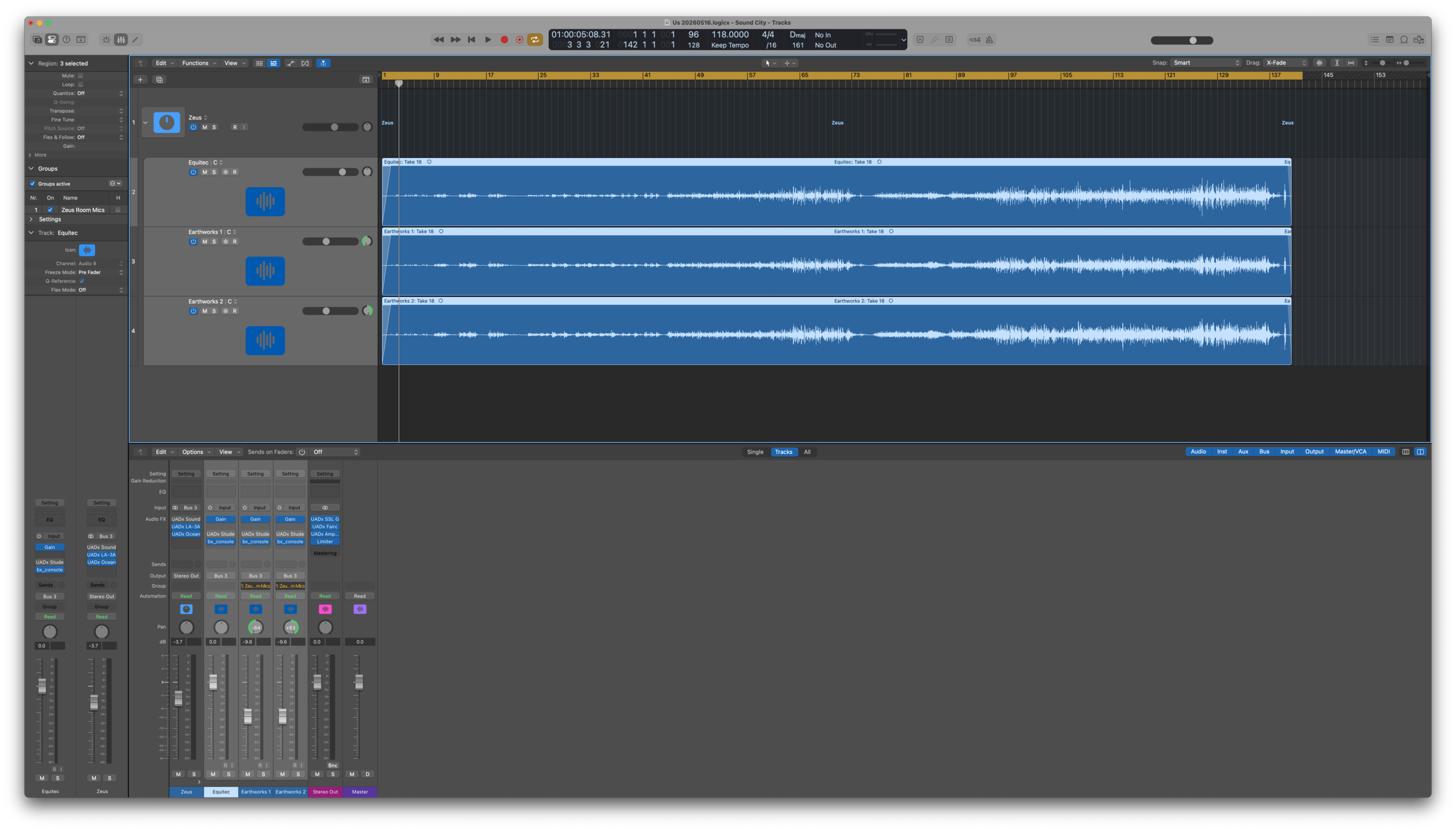
Special Mix Prep Notes (Post‑Tracking, Pre‑Mixing)
- After some clip gain adjustments (shooting for -18dB RMS), I exported all the files out of Logic and brought them into Luna for mixing.
Special Mixing Notes

- Submasters: Created a group sub‑master for the guitar tracks.
- Brainworx SSL 9000 J: Used on each of the guitar channels for tone shaping.
- Fairchild 670: Used on a send with modified settings (adjusted Input and Threshold from the default) for parallel compression.
- LA‑3A: On the group sub‑master using the “Acoustic Guitar” preset. (Got this idea from a Bob Clearmountain video.)
- Ocean Way Studios: Used in reverb mode on a send.
- Capitol Chambers: Used with a modified version of the “Acoustic Guitar Chamber 6” preset.
- Mix Bus processing: Black Box (“17 Mix Bus 1” preset), SSL G Bus Compressor (modified Default setting), Fairchild 670 (Modified Stereo Bus preset), ATR-102 (modified Default setting)
Special Mastering Notes
- Target LUFS: Aimed for approximately -16 LUFS (preserving the wide dynamic range – very soft to triple forte).
- Ozone settings:
- Vintage Tape: “Clean Fifteen” preset
- Equalizer: -1.2 dB @ 239 Hz (Bell, Q 8.9), +0.6 dB @ 10.7 kHz (Shelf, Q 24.0)
- Imager: 0‑70Hz = 0.0, 70‑2.7kHz = 24.1, 2.7kHz‑11.8kHz = 32.9, 11.8kHz‑20kHz = 41.8
- Vintage Compressor: “Smooth Opto” preset – threshold -22.6, ratio 1.5:1, attack 37.8ms, release 69.6ms
- Maximizer: IRC IV “Modern”, threshold -7.2 dB, ceiling -4.3 dB, Character 2.60
- Dither: POW‑r #2 when converting from 24‑bit to 16‑bit.
Identity is now available on all streaming platforms (such as Spotify), or you can also listen to it on Bandcamp.